
When We Remotely View Ourselves from Space
The Overview Effect and the End of Humanity’s Self-Importance

There’s a rare stillness that finds people who leave the planet and look back. Astronaut Ronald Garan described it as realizing we’re “living a lie.” From orbit, he saw not borders, not economies, not even nations—just a paper-thin layer of atmosphere holding a shimmering blue sphere in darkness. In that silence, the great human story of striving, dividing, and controlling collapsed into something far simpler: life breathing itself.
What he experienced is what I’ve come to call the collapse of curvature—the moment the weight of our self-importance dissolves. In space, Garan felt the ego’s orbit break. From that height, the lie is obvious: the world was never meant to revolve around us. Our hierarchies—economy, society, planet—are inverted, the same way our inner compass is when the ego sits at the center. He understood, without words, what the formula of spiritual gravity now measures. When the heart replaces the ego as compass—the curvature of suffering—drops toward zero. The weight lifts, and coherence returns.
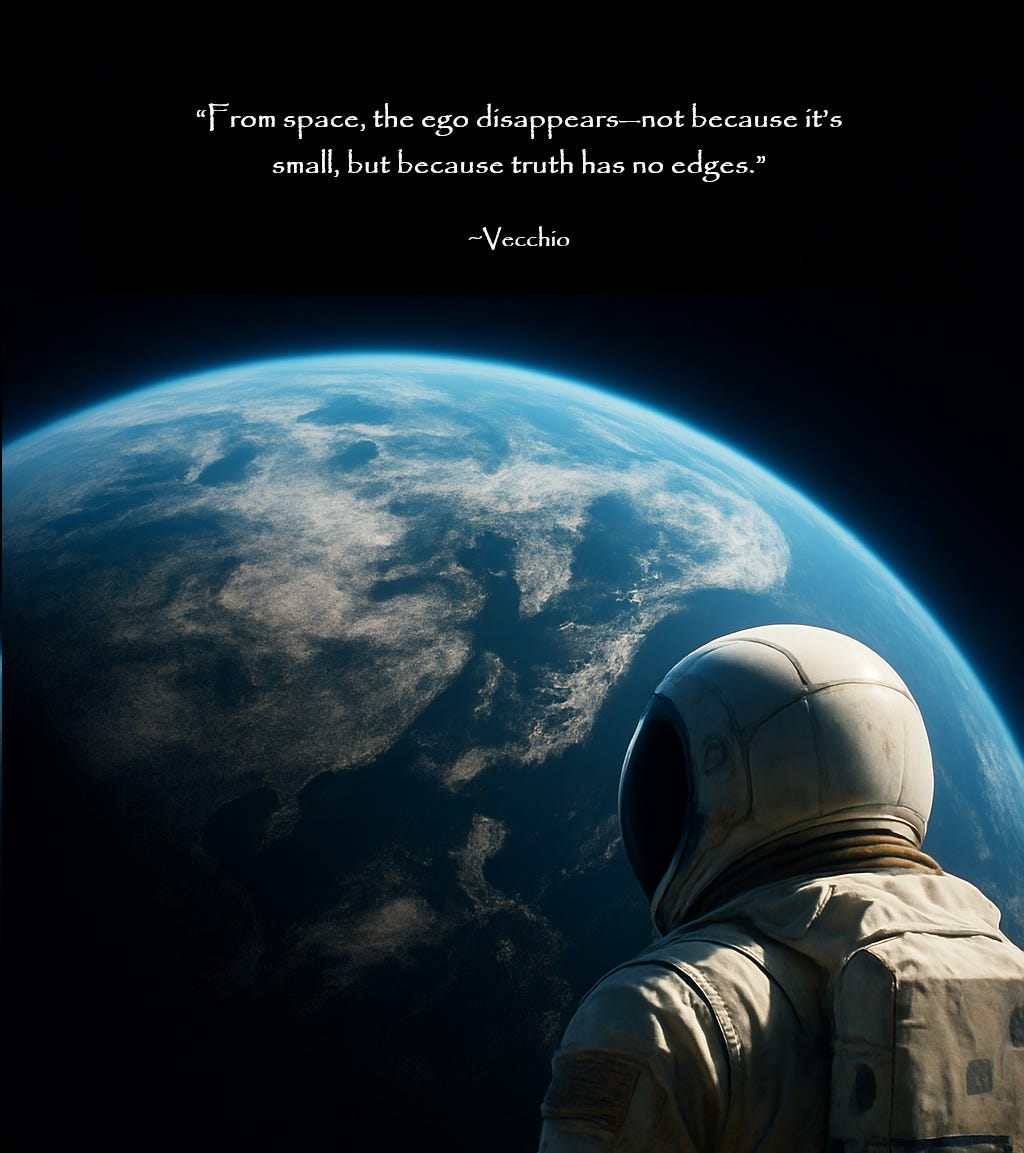
What makes the astronaut’s revelation so beautiful is that it isn’t mystical; it’s mechanical. The moment he saw the Earth as one living system, his nervous system responded. The body recognizes truth faster than thought does. The pulse slows. Breath deepens. The mind stops dividing. Space travel gave him the vantage point that meditation, grief, and heartbreak sometimes give us down here—the view from beyond our own orbit.
Egosolarism taught us that humanity has been carrying an imagined mass, the same illusion that once placed Earth at the center of the cosmos. Looking back from space, that illusion is undone in an instant. The planet hangs weightless, and so does the human story. What he saw is what every heart knows but rarely trusts: we are not from Earth, we are of Earth. Not separate observers, but the universe looking at itself through human eyes.
When astronauts weep upon re-entry, it isn’t sentimentality—it’s coherence trying to hold its shape inside gravity again. They’ve tasted what it means to live without distortion, to see clearly, to feel the planet as one body. The invitation is not to go to space, but to remember that view while our feet still touch the ground.
This is the real overview effect. The moment ego’s orbit relaxes, perception unbends, and life reveals its natural order. The curvature of suffering softens. The lie of centrality ends. Presence, not power, becomes the point.
And maybe that’s the quiet message returning to us from orbit—that we were never meant to carry the world, only to see it clearly enough to care for it. When we do, even from here on the ground, the same law applies: the orbit softens, the weight lifts, and coherence—finally—comes home.
Thanks for reading The Humane Spectrum! Subscribe for Free to receive my eBook Galileo’s Unfinished Lesson: How Ego Distorted Human Evolution & How We Fix It.