
When Truth Refuses the Marketplace
Why I hesitate in the age of influence

It has become increasingly clear to me that we are living in a time when many people can feel that something is wrong with the world, even if they do not yet have the language to say exactly what it is.
The old structures are straining. People are exhausted. Relationships feel thinner. Meaning feels less stable. Attention is frayed. Trust is low. Across many different spaces — trauma, healing, embodiment, spirituality, psychology, personal development, consciousness, leadership — people are trying, in their own way, to do something that matters. They are trying to make sense of what is happening. They are trying to reduce suffering. They are trying to help.
I do not question that sincerity.
What I question, more and more, is whether much of what is being said is actually reaching the center of the problem.
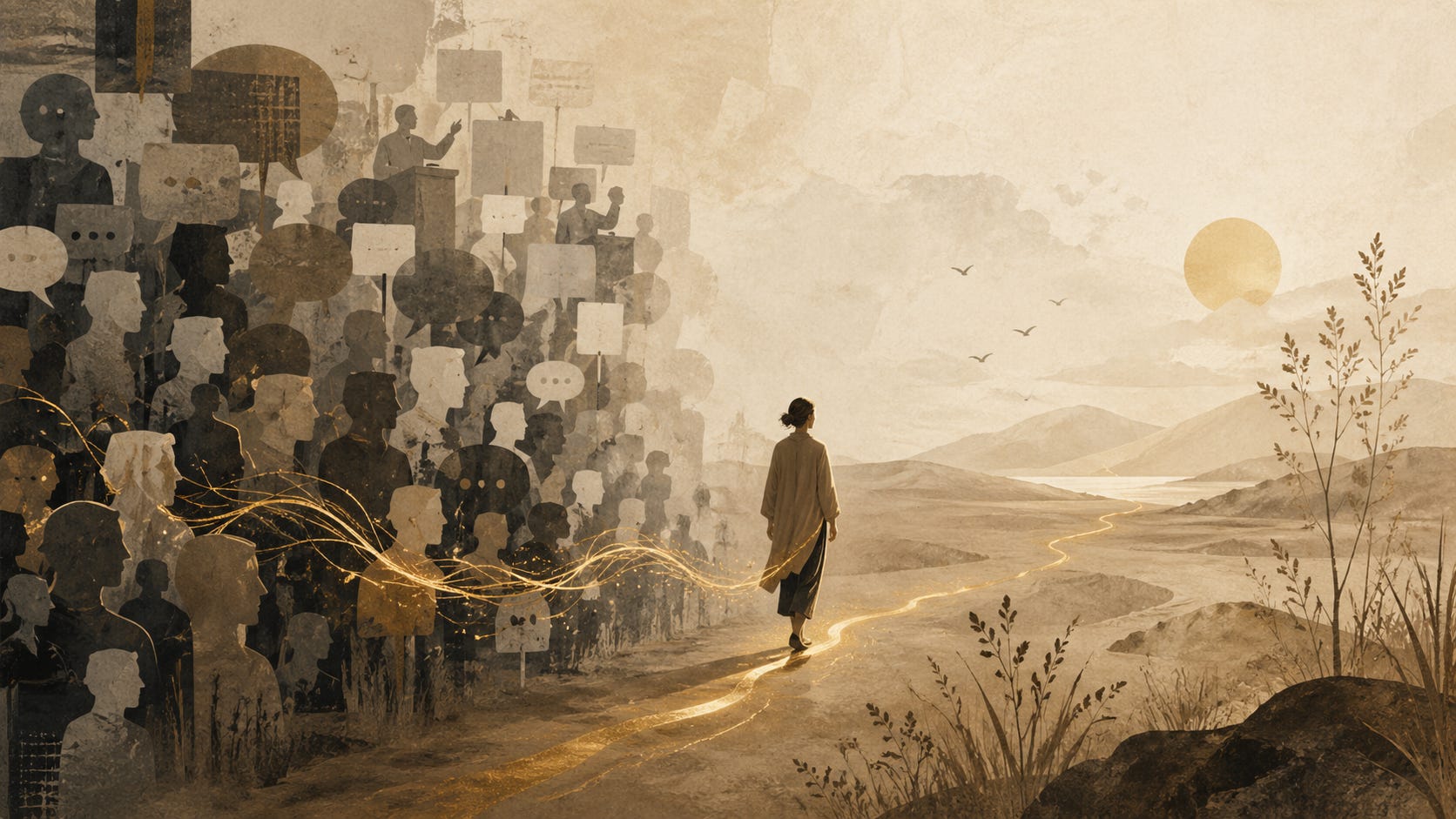
I understand why so many people speak from their own healing. Human beings suffer, make meaning of what they have lived through, and want to offer something onward to others. In one sense, that is no different from what my patients have done for years in the therapy room. A person hurts, survives, learns, and naturally wants to pass that learning on. That is human. Often it is generous. Sometimes it is even wise.
But there is a difference between what life taught me and what suffering has taught us.
That difference matters.
Much of the public healing space now feels organized around personal revelation becoming public authority. Here is what happened to me. Here is what I learned. Here is the method that helped me become more myself. I do not say that to mock it. Some of it is sincere. Some of it is thoughtful. Some of it is genuinely helpful in part.
But what I carry does not feel like the world according to me.
I do not mean that I possess truth as private property. I mean something quieter than that. I have witnessed a pattern deeply enough, through my own life and through the lives of thousands, that something true keeps revealing itself. I did not invent it. I kept seeing it. Across different symptoms, histories, personalities, wounds, and ways of adapting, the same deeper structures kept appearing.
That is why what matters most to me now feels less like opinion and more like witness.
It is coming from us, to us, for us.
And perhaps that is why I have such difficulty with the culture of influence, especially in spaces that sit near my own. I read many thoughtful people. I see intelligence. I see earnestness. I see pain turned into language and language offered as guidance. But I also keep feeling the same tension: many are describing one layer of the problem while leaving the deeper center untouched.
One person says the issue is behavior. Another says the nervous system. Another says subconscious story. Another says embodiment. Another says spirituality. Another says identity. Each may be touching something real.
But underneath all of those remains a more primary question:
What in us is actually leading?
If the ego remains the one trying to save itself, then behavior change can become performance. Nervous system work can become regulation in service of the old center. Spirituality can become bypassing. Healing can become self-improvement. Identity work can become the renovation of the false self. Even awakening can become another egoic ascent.
That is why so much of “the work” does not stick.
And I suspect that is why, for decades now, people have spoken about “the shift,” “the awakening,” “the new human,” and every other threshold phrase imaginable, while the culture remains so visibly organized around the same old distortions. The language changes. The methods change. The personalities change. But often the center does not.
So the shift stays perpetually ahead of us.
Not because nothing is happening.
Not because no one is sincere.
But because we keep trying to heal and evolve while still speaking from the very center that distorts the field.
This is where my hesitation begins.
Because when I read someone circling a real truth while stopping short of that deeper question of center, I often want to respond. Then I immediately feel as though I am trespassing.
That word has become important to me: trespassing.
Because that is how it feels to step into someone else’s public writing carrying something weightier than the usual affirmation. Their page is open, yes. Their work is public. But it is still their field, their frame, their tone, their following. To arrive there with a deeper distinction can feel less like conversation and more like walking onto someone else’s property without invitation.
And I do not like that feeling. If I’ve done this to you, please forgive me; that was not my intent.
It is exposing enough to carry truths that were not cheaply purchased. It is another thing altogether to offer them in fragments beneath someone else’s carefully shaped worldview and then hold my breath, hoping they do not gag. That is not how truth wants to move. Or at least not the kind of truth I’ve come to honor.
What I have come to call ‘the signal’ is not simply content. It is not a hook, a take, or a polished insight. The signal is what comes through when the distortion quiets enough for something truer to be felt. The one speaking does not own it. It moves through them. That is why it can be recognized across strangers, stories, and cultures. It belongs less to personality than to coherence.
But the signal does not live well in every medium.
It can be flattened into influence.
It can be reduced to self-positioning.
It can become my truth, my journey, my method, my brand.
It can even become another distortion of the very thing it was meant to correct.
That, I think, is part of what we are living in now: not a landscape of complete falsehood, but one crowded with partial truths amplified into authority. People are genuinely trying to help. I believe that. They are frustrated with the world. They want to make things better. But wanting to reduce suffering and naming the problem clearly are not always the same thing.
This is the hardest thing to say.
We do not suffer merely because we have wounds. We suffer because consciousness keeps bending around fear, shame, adaptation, self-protection, and mistaken identity as though those were the truth of who we are. That distortion then gets spiritualized, intellectualized, optimized, embodied, regulated, narrated, branded, and sold back to the world as healing.
But if the center is still wrong, then even the most beautiful method can become another refinement of the same old confusion.
That is why I have never been able to fully join the healing marketplace. Not because there is nothing worthwhile there, and not because I imagine myself above it, but because what I have come to know does not feel like something to be marketed as the world according to me. It feels more like a witness to something collective — something profoundly human, something belonging to no single brand, no single teacher, no single method, and no single personal story.
I care about a humane understanding of the human condition. I care about the difference between feeling and emoting, between being seen and being met, between spiritual language and spiritual truth, between a life organized around an exaggerated ego and a life organized around the true human center. I care about the possibility that suffering is often not pathology first, but distortion, and that healing may be less about becoming something new than remembering what we were first.
That is the lane I stand in.
Not memoir, though I have a story.
Not coaching, though I can guide.
Not guru spirituality, though I know there is more to us than psychology alone.
Not influencer culture, though I publish in public.
What I am trying to speak to is the human condition from the inside out.
Perhaps that is why I have been slow to “build” anything online. I have not wanted to gather a following simply to monetize attention. I have not wanted to perform certainty. I have not wanted to market transformation as though it were a guaranteed outcome. I have not wanted to reduce a collective truth into personal branding. And I have not wanted to trespass into other people’s fields with fragments of signal that deserve a fuller container.
Still, silence has its own cost.
If those who can hear the difference between signal and performance remain quiet, then the conversation continues to be shaped mostly by what is marketable rather than what is most true. So perhaps this is my own quiet correction. Not a complaint. Not a declaration of superiority. Only a clarification of where I stand and why I have hesitated.
If I speak here, I want to do so from my own ground.
And if others working in these adjacent spaces recognize something in what I am saying, then please know that I desire our conversations to happen by invitation rather than intrusion. Not because truth needs permission to exist, but because some truths deserve enough room to be met, not merely noticed.
I am less interested in building an audience around myself than in helping create a field where what is most humane can be recognized. Less interested in influence than in coherence. Less interested in being understood by everyone than in speaking clearly enough that those who know the difference between personal story and collective signal can feel it.
Please understand, my writing here is not the world according to me.
It is an offering from one person who has listened long enough to know that what matters most was never mine alone.
Everything I share here is always coming from us, to us, for us.
Thanks for reading The Humane Spectrum! Subscribe for Free to receive my eBook Galileo’s Unfinished Lesson: How Ego Distorted Human Evolution & How We Fix It.