
When Life Gets Too Hot
What a new universal law in biology may reveal about feeling, emotion, suffering, and the curve of human coherence.

Recently, scientists identified what they are calling a Universal Thermal Performance Curve, a mathematical pattern that appears across living systems. The discovery is remarkable because it suggests that organisms as different as bacteria, plants, insects, fish, reptiles, birds, and mammals may all follow a similar relationship between temperature and performance. As temperature rises, biological activity tends to increase. Life becomes more active, more capable, more efficient. But only to a point. Once the system passes its optimal range, performance does not simply taper off. It can decline rapidly, sometimes toward physiological failure or death. The curve appears to unify tens of thousands of biological measurements across thousands of species, suggesting that evolution itself may operate within a lawful constraint it cannot simply escape.
That alone is worth pausing over.
For many of us, evolution is imagined as nearly limitless adaptation. Given enough time, pressure, and variation, life finds a way. And often it does. But this new biological curve suggests something more sober and perhaps more profound: life adapts within boundaries. It can stretch, adjust, reorganize, and survive, but it does not become exempt from the deeper structure of reality. Temperature can animate life, but too much temperature overwhelms it. Heat can support function, but beyond tolerance, the same heat becomes destabilizing. The force that activates can also collapse.
This is where the finding begins to echo something I have been trying to describe in the inner life.
In my own work, I have been exploring what I call spiritual gravity, egosolar existence, intentional evolution, and the curvature of suffering. These are not meant as religious claims. They are attempts to describe the lawful way human experience bends. The basic premise is that human beings are not broken by design. We are adaptive by design. The ego forms as a necessary function. It helps us survive, interpret, organize, defend, and move through a complex world. But the ego was never meant to become the center of the whole system.
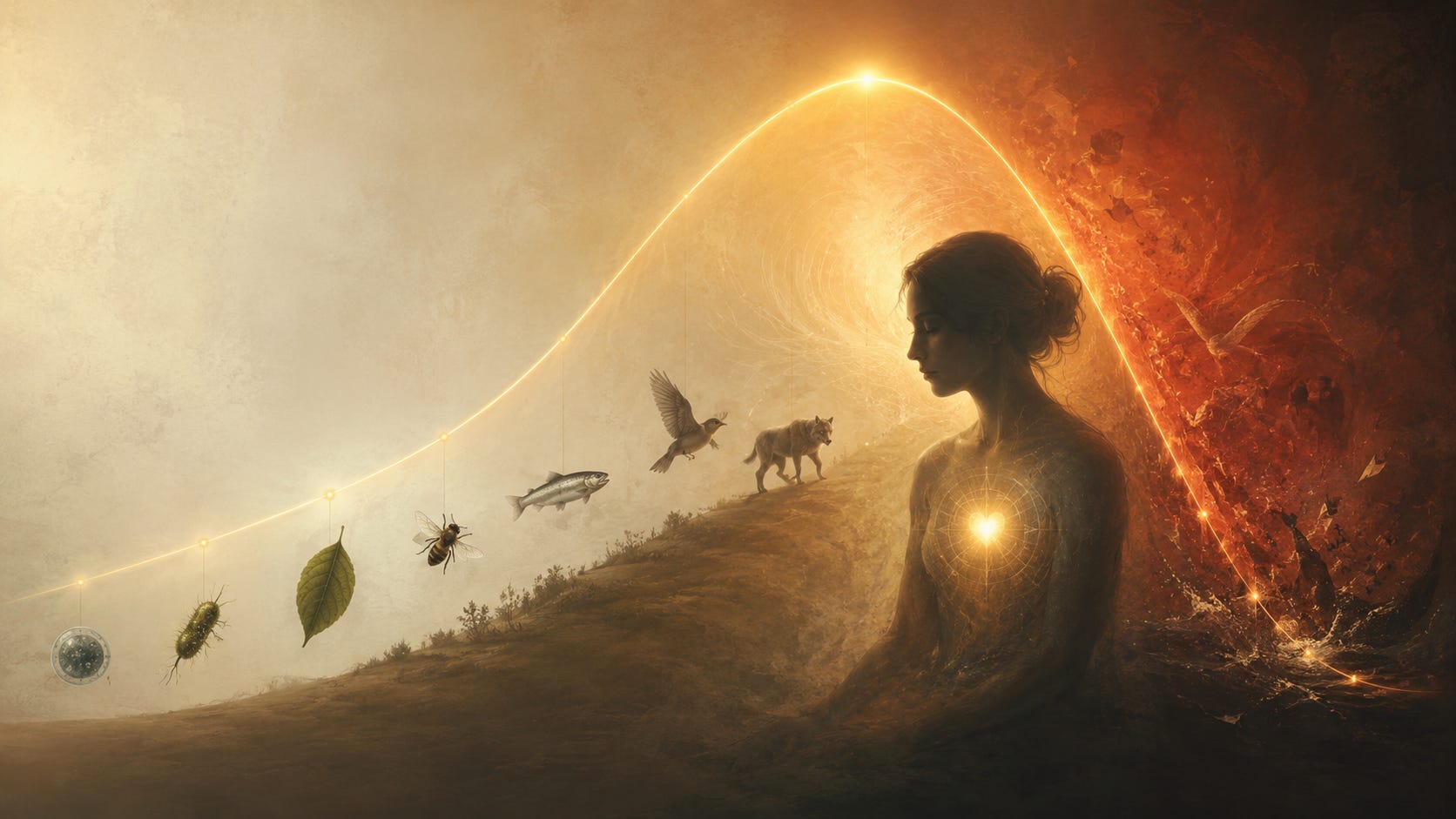
When it does, the person begins to live as though the adaptive function is the sun around which all experience must orbit. This is what I have called egosolarism. Life still happens, but now it is interpreted through a distorted center. The ego takes on too much mass. Fear, guilt, shame, identity, memory, belief, and defense begin to bend perception. The person may still be functioning, but their inner world is no longer organized around coherence. It is organized around survival interpretation.
That is where suffering increases.
The biological curve gives us a useful analogy. Temperature is not bad. In fact, without the right temperature, life cannot function well. But when heat exceeds the organism’s tolerance, performance collapses. Likewise, ego is not bad. Ego is necessary. But when egoic load exceeds the person’s capacity for heart-centered orientation, experience begins to distort. What began as adaptation becomes reactivity. What began as protection becomes rigidity. What began as interpretation becomes misinterpretation.
This may be one of the most important parallels between biology and subjective life: systems often fail not because the activating force is wrong, but because the system is pushed beyond its coherent range.
This distinction also helps clarify the difference between feeling and emotion.
Feeling, as I understand it, is closer to the organism’s original signal. It is the spirit’s felt contact with life. It is sensation, ache, warmth, contraction, tenderness, grief, longing, fear, or intuitive knowing before the ego has fully explained it. Feeling is not yet a story. It is information arriving through the human system.
Emotion is different. Emotion is what happens when a feeling becomes paired with a belief.
A child feels fear. The ego pairs it with, “I am not safe.”
A person feels sadness. The ego pairs it with, “I have been abandoned.”
Someone feels shame. The ego pairs it with, “There is something wrong with me.”
Another feels anger. The ego pairs it with, “I am being disrespected.”
At that point, the feeling has become organized by meaning. Sometimes that meaning is accurate. Often, especially in trauma, it is distorted by history. This is why I have begun thinking of emotion as a kind of internal thermometer. It tells us not only what feeling is present, but how much interpretive heat has been added to it.
A feeling can be clean. An emotion can be loaded.
The more exaggerated the belief, the hotter the emotional field becomes. A feeling of concern becomes panic. A feeling of sadness becomes despair. A feeling of guilt becomes self-condemnation. A feeling of uncertainty becomes dread. The ego is no longer simply helping the person interpret life. It is heating the whole system.
And like the biological curve, there is a threshold.
Below that threshold, emotional life can guide us. It can deepen empathy, clarify boundaries, invite repair, awaken compassion, or reveal what matters. But above that threshold, emotion stops guiding and starts flooding. The person is no longer feeling life clearly. They are emoting through a belief that has overheated the system.
This is where my curvature law enters.
In my ΔS work, I have proposed that suffering can be understood as a remainder created when egoic mass bends experience away from coherent orientation. Put more simply: suffering increases when the ego becomes too heavy and the heart is no longer functioning as the compass. In the formal paper, I describe this as the difference between universal curvature and subjective curvature — between what is happening and the distortion added by interpretation. The claim is not that the external world is painless. The claim is that much of human suffering is intensified by the way experience bends around the wrong center.
The new biological law does not prove this. It would be careless to say it does. But it does make the larger idea more plausible: perhaps complex systems, whether biological, psychological, cultural, or even artificial, are governed by lawful threshold dynamics. They activate. They adapt. They reach optimal ranges. They compensate. Then, if pushed too far, they distort or collapse.
In biology, the variable is temperature.
In subjective life, the variable may be egoic load.
In biology, performance rises with warming until the organism reaches its optimal range, then declines rapidly beyond it. (Universidad de Granada) In human experience, feeling may become adaptive emotion until the belief attached to it creates too much internal heat. At that point, the person does not become more conscious. They become more reactive. They do not see more clearly. They bend the field around fear, shame, guilt, injury, or identity.
The result is not pathology in the deepest sense. It is misalignment.
This matters clinically. It changes what we are looking at when someone is anxious, depressed, reactive, ashamed, compulsive, or emotionally overwhelmed. We are not simply looking at symptoms. We are looking at a system that may have crossed its coherence threshold. The task is not to shame the ego for overheating. The task is to help the person return to the range in which feeling can be felt without being distorted.
This is what intentional evolution means to me.
The psyche is not waiting for us to impose healing from the outside. It already contains a self-correcting intelligence. But that intelligence cannot function well when the ego is overheated, overcentered, or overburdened. The ego must be reoriented to its proper task. It is not the compass. It is the adapter. It is not the sun. It is a function within the field. When the heart returns as compass, the system does not become passive. It becomes better ordered. Feeling becomes usable again. Emotion becomes information rather than weather. Suffering begins to decrease because the person is no longer adding unnecessary curvature to what is already difficult.
That, to me, is the quiet power of this biological discovery.
It reminds us that life has structure. It has range. It has thresholds. It has lawful limits that cannot be overcome by force, denial, or ideology. And perhaps the inner life is no different. Perhaps the human being also has an optimal coherence range. Too little feeling, and we become numb. Too much egoic heat, and we become reactive. But when feeling is held by the heart and interpreted with humility, the system finds its range again.
The lesson is not that biology and consciousness are the same. They are not.
The lesson is that life may keep teaching us the same pattern in different languages.
A cell overheats.
A forest dries.
A culture polarizes.
A nervous system floods.
An ego mistakes itself for the center.
In each case, the question is not simply, “What is wrong?”
The better question may be, “What has exceeded its coherent range?”
That question changes everything.
Because if suffering has a curve, then healing is not random. If emotion has a threshold, then presence is not sentimental. If the ego can overheat the field, then the heart is not merely poetic. It is regulatory. It is orienting. It is the cooling intelligence that allows life to return to its natural performance.
Biology has shown us that living systems cannot exceed their limits without consequence.
The inner life may be asking us to learn the same law.
Not as theory.
As practice.
Not as belief.
As return.
References
Arnoldi, J. F., Jackson, A. L., Peralta-Maraver, I., & Payne, N. L. (2025). A universal thermal performance curve arises in biology and ecology. Proceedings of the National Academy of Sciences. (PNAS)
University of Granada. (2025). A universal formula is developed to predict the impact of temperature on living beings. (Universidad de Granada)
Vecchio, E. L. (2025). What ΔS Contributes to the Consciousness Debate: The First Geometry of Subjective Experience.
Thanks for reading The Humane Spectrum! Subscribe for Free to receive my eBook Galileo’s Unfinished Lesson: How Ego Distorted Human Evolution & How We Fix It.