

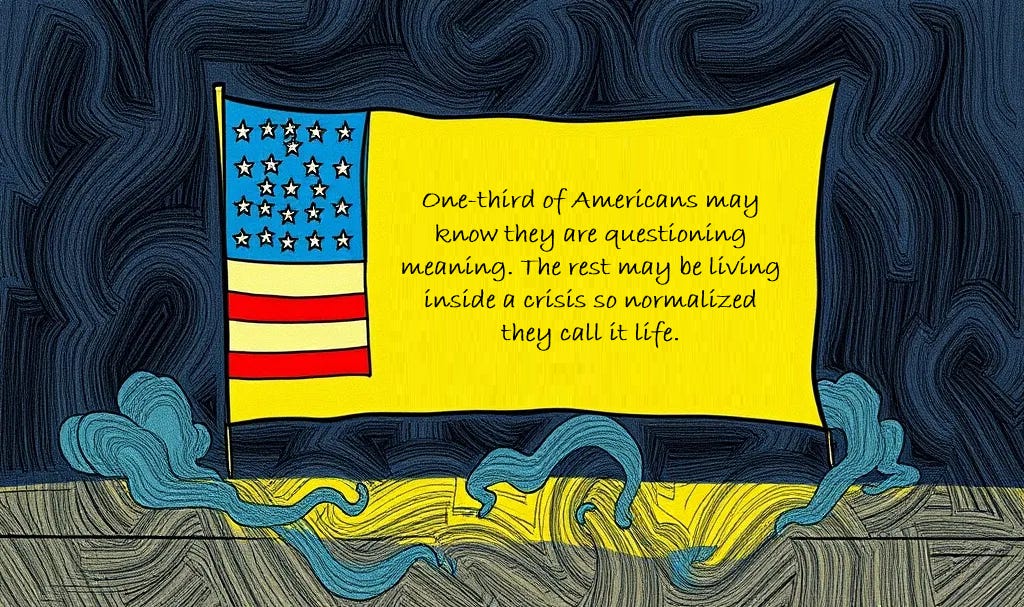
There is a recent article making the rounds that says roughly one-third of Americans are having an existential crisis. The number itself is interesting, and I do not dismiss it. If that many people are consciously questioning meaning, identity, agency, purpose, and the direction of their lives, then something real is pressing through the cultural surface. The article notes that this crisis is especially high among younger generations, with more than half of Generation Z reporting some version of this struggle, and it frames the matter as a modern crisis of meaning that leaves people caught between nihilism, rational certainty, or faith.
But I cannot help noticing the irony.
The article is trying to diagnose an existential crisis from inside the very structure that creates one. It asks how many people are questioning meaning, but it does not ask what part of the human being is doing the questioning. It assumes the crisis begins when a person becomes uncertain about identity or purpose, but in my work with trauma, I have come to see something deeper. The existential crisis does not begin when someone finally asks, “Who am I?” or “Why am I here?” Those questions often mark the moment when the crisis has become conscious. The crisis itself begins much earlier, when the ego is installed as the center of human life and then asked to answer questions it was never designed to answer.
That is the grander existential crisis.
The ego can construct an identity, defend a belief, join a tribe, pursue success, obey a religion, reject a religion, accumulate knowledge, achieve status, create a philosophy, and even build a life that looks admirable from the outside. What the ego cannot do, when displaced into the center, is know what the human being is. It can narrate a life, but it cannot become the source of life. It can adapt to the world, but it cannot serve as the compass for the whole psyche. And yet, in much of modern life, this is exactly what we have asked it to do.
So when I read that one-third of Americans are having an existential crisis, I hear something true but incomplete. One-third may know they are in crisis. One-third may have reached the point where the questions have become conscious enough to report. But from the perspective of the work I have witnessed in thousands of suffering people, the percentage is much closer to ‘universal’ among those living inside an ego-centered culture. The crisis is not only the visible questioning of meaning. It is the largely invisible condition of living from a false center and calling that life.
This matters because we have confused functioning with coherence.
A person can be productive and existentially displaced. A person can be religious and existentially displaced. A person can be successful, admired, educated, moral, busy, politically certain, spiritually fluent, or socially impressive and still be living inside an existential fracture. The fracture is not always dramatic. It may not look like despair. Sometimes it looks like ambition. Sometimes it looks like certainty. Sometimes it looks like self-improvement. Sometimes it looks like righteousness. Sometimes it looks like a life so full of activity that the deeper question has no room to breathe.
That is why the crisis is larger than the survey can measure.
The person who says, “I do not know who I am or why I am here,” is in an overt existential crisis. But the person who never asks because they are entirely organized around achievement, appearance, ideology, survival, grievance, family role, religious certainty, wealth, productivity, or social identity may be living inside the same crisis in a more hidden form. Their ego has supplied answers, but those answers may be protecting the person from the deeper question rather than resolving it.
In my language, the crisis begins when the human being forgets what they are and becomes trapped in who, when, and where. Who am I in the eyes of others? When will I arrive, succeed, heal, be loved, be recognized, be safe? Where do I belong, politically, socially, religiously, professionally, relationally? These questions are not wrong. They are part of life. But when they become the whole of life, the human being becomes flattened into identity, time, circumstance, role, tribe, and survival. The deeper questions — what am I and why am I here — become buried under the ego’s need to manage existence.
This is the true existential crisis: the adaptive self attempting to define the meaning of a life it was only meant to help navigate.
And this is why the usual answers are not enough.
The article suggests that modern people are left, for all practical purposes, with nihilism or faith. Nihilism says there is no meaning, so the person must live without it or create meaning from nothing. Faith says meaning is received through belief, often through a religious framework. I understand why the article frames the matter this way, and I understand why faith can save many from meaninglessness. But from the perspective of what I have learned in trauma work, this still leaves something essential unnamed.
Meaning is not merely invented by the ego, and it is not only imported through doctrine. Meaning can also be revealed when the human system returns to right relationship.
That is the missing third path.
It is not nihilism. It is not belief as escape. It is not rational certainty. It is not self-created purpose as another ego project. It is reorientation. It is what happens when the Observer can witness without collapsing into the story, when the spirit can feel what has been carried too long, when the ego can return to its lawful function as adapter rather than ruler, when the heart resumes its role as compass, and when the body-field finally registers coherence. In that alignment, meaning is not forced. It begins to appear.
This is what I have seen again and again in people who have suffered severely.
They do not awaken because trauma is good. Trauma is not good. Some things should never happen. But the psyche, when wounded, carries a self-correcting intelligence that the ego alone cannot access. Severe suffering can break open the ego’s certainty, not as punishment, but as consequence. The old structure fails. The familiar identity can no longer explain the pain. The person who survived by controlling, pleasing, performing, hiding, numbing, or defending reaches the end of that architecture, and something deeper begins knocking.
This is not a romantic claim. It is a clinical one, but one that clinical language often fails to honor.
I have watched human beings go through experiences that resemble dying and being born again, not as religious theater, but as psychic reality. The old self dies because it cannot carry the truth. The survival identity collapses because it was never the whole person. The ego resists this collapse because it believes surrender is annihilation. It believes that if it stops managing, defending, interpreting, and controlling, the person will disappear. But the person does not disappear. What disappears is the false centrality of the ego. What emerges is not a new personality, but a more lawful relationship among the parts of the human system.
This is why I hear the phrase “Christ figure” differently in the context of suffering people. I am not using it to make a doctrinal claim or to diminish the sacred meaning others attach to Christ. I am using it to point toward a recurring human pattern: the descent, the suffering, the surrender of the false self, the passage through helplessness, and the emergence of a life no longer organized around the same center. In trauma work, I have seen many people enact this arc in quiet, ordinary, devastatingly human ways. They did not become holy in the religious sense. They became more truthful. More compassionate. More present. More humane. They died to the identity that survived and were born again into the self that could finally live.
That kind of awakening is often unavailable to the ego until the ego returns to its lawful relationship with the whole.
The ego cannot lead the person into this because the ego’s first loyalty is protection. It wants the known pattern, even if the known pattern hurts. It wants control, even when control prevents healing. It wants identity, even when identity has become a prison. It wants certainty, even when certainty keeps the person from truth. It wants to solve the existential crisis by creating a better narrative, a stronger belief, a more attractive self, a more convincing explanation, or a more secure place in the world.
But the deepest crisis is not solved by the ego manufacturing meaning. It is resolved when the ego stops pretending to be the source of meaning.
This is what I mean when I say the ego is blind to the humane potential of human beings. It is not blind because it is bad. It is blind because its function is not designed to see the whole. The ego sees threat, role, identity, comparison, history, strategy, and survival. It sees the world through the conditions that shaped it. It can become a very useful servant, but a tragic master. When it takes the center, it cannot imagine a humane universe because it cannot imagine a life not organized around defense.
And yet, the humane potential remains.
It appears whenever the heart becomes compass again. It appears when a person stops mistaking pain for identity. It appears when suffering becomes signal rather than punishment. It appears when shame loosens, grief speaks, the body exhales, and the person realizes that they were never only the wound. It appears when someone can finally say, “This happened to me, but it is not what I am.” It appears when compassion includes the self. It appears when strength no longer requires armor. It appears when truth is no longer used as a weapon. It appears when the human being no longer has to become special in order to belong to life.
This is life as intended.
Not a life without pain. Not a life without loss, conflict, disappointment, limitation, or uncertainty. Life as intended does not mean the absence of suffering. It means suffering is no longer needlessly amplified by misinterpretation. It means pain is allowed to become information. It means grief can move. It means fear can be heard without being obeyed. It means the ego can adapt without ruling. It means the heart can orient without being dismissed as sentimental. It means the soul, as Observer, can witness life without being trapped inside the ego’s story of it.
From this perspective, the existential crisis is not primarily that modern people lack meaning. It is that modern people have normalized an inhumane structure of meaning. They have been taught to organize around achievement, productivity, visibility, identity, certainty, ideology, consumption, and control, and then wonder why the soul feels absent. They have been told to find themselves in roles, brands, beliefs, relationships, careers, causes, and tribes, while the deeper self waits beneath all of that for the person to ask a more original question.
Not “Who am I supposed to be?”
But “What am I, before life required me to become someone?”
That question is dangerous to the ego because it loosens the architecture of survival. It asks the person to stop confusing adaptation with essence. It asks them to see that much of what they called identity may have been protection. It asks them to grieve what was lost, feel what was buried, and return to the heart as the only compass capable of guiding the whole person back into coherence.
This is why the ego resists catharsis.
Catharsis is not merely an emotional release. It is a reorganization of the field. It is the moment when the old interpretation breaks open and the body, spirit, ego, heart, and Observer come into a new relationship with what happened. The ego fears this because catharsis removes its monopoly on meaning. It no longer gets to tell the whole story. It no longer gets to define the person as victim, failure, sinner, hero, survivor, achiever, rescuer, or broken thing. It has to yield to a larger truth.
And when it does, something astonishing often happens.
The person does not become less human. They become more human. They become more available to tenderness, humility, honesty, humor, responsibility, and love. They become less interested in performance and more interested in presence. They become less controlled by old shame and more capable of relationship. They become less concerned with proving their worth and more willing to participate in life. They do not escape the human condition. They enter it more truthfully.
This is the awakening severe trauma sometimes leaves behind as a residual grace of a self-correcting psyche. Not because trauma is sacred, but because the psyche is. Not because pain is desirable, but because life, even through pain, continues pressing toward coherence. Not because suffering automatically enlightens, but because when suffering is held with enough presence, the ego’s false center can no longer sustain its illusion.
The article says one-third of Americans are having an existential crisis. I would say one-third may have become aware enough to report the ache. The rest of us, to one degree or another, are living inside the larger crisis of egoic displacement and may simply be too busy, defended, certain, entertained, frightened, successful, religious, ideological, or exhausted to name it.
The grandest existential crisis is not that people cannot find meaning.
It is that the ego keeps trying to manufacture what only coherence can reveal.
And the way through is not despair. It is not forced belief. It is not another identity. It is not another performance of healing. It is the return of the human system to its lawful relationship: Observer witnessing, spirit feeling, ego adapting, heart guiding, and the body registering the truth of alignment. When this happens, meaning is not imposed on life. It rises from life. It becomes less something we chase and more something we inhabit.
This is why I say the message is coming from us, for us, to us.
It is not the world according to one teacher, one theory, one religion, or one wounded man trying to explain his own life. It is something much larger and far more humbling than that. It is the field speaking through thousands of human beings who were carried to the edge of what the ego could manage and, in that breaking, discovered that something deeper had never left them. These were not people who merely survived trauma and returned to the same life with better coping skills. They were people whose suffering revealed an inner intelligence already trying to guide them toward a more humane relationship with themselves, with others, and with life itself.
They became the witnesses and the evidence, not because trauma made them wise, but because the psyche, when held with enough presence, showed its self-correcting nature through them. They taught me that life as intended was never truly lost. It had been covered by life as it is, buried beneath fear, shame, guilt, adaptation, survival, and the ego’s mistaken belief that it had to become the center in order to keep the person alive.
Perhaps this is the real answer to the existential crisis. We do not need to invent a purpose large enough to survive meaninglessness, nor do we need to leap blindly into belief because the alternative feels like despair. What we need is to return to the inner architecture that allows meaning to become visible in the first place. Meaning does not have to be manufactured by the ego or borrowed from the outside. It begins to reveal itself when the human system comes back into right relationship.
The ego cannot see the humane universe because, when displaced, it is organized around survival in an inhumane one. But the heart can sense what the ego cannot imagine. The soul can witness what the ego keeps defending against. The spirit can feel what the ego has learned to manage. The body can register the truth of coherence before the mind has words for it. And when the ego finally stops trying to be the sun, the human being begins to remember the warmth of what had always been behind them.
This is not fantasy. It is the true evolution trying to happen through us.
Thanks for reading The Humane Spectrum! Subscribe for Free to receive my eBook, Galileo’s Unfinished Lesson: How Ego Distorted Human Evolution & How We Fix It.