
Love Simply Is
The Habit of Distrusting Our Own Perception.

There’s a kind of rigor that reveals truth — and another kind that hides it.
I’ve spent a lifetime in proximity to suffering. Not theorizing it. Not treating it as data. But sitting with it, feeling its texture, watching how it moves when it’s allowed to speak. And over time, I’ve come to recognize something that doesn’t require a research study to prove: truth leaves a trail.
It’s observable. It’s consistent. It holds up under the weight of direct experience.
This isn’t to dismiss science. But the scientific method isn’t the only path to what’s real. There are truths you don’t need to measure because they’re already clear. If someone steps in front of a moving truck, they don’t need to “believe” in physics — gravity makes itself known. The same is true of what I’ve come to call spiritual gravity. It’s just as reliable. And when we ignore it, the crash may not break our bones — but it breaks something else. Something essential.
In a culture addicted to intellectual validation, we’ve made a habit of distrusting our own perception. We’ve trained ourselves to second-guess what’s felt, to sideline what’s known in the body, and to elevate only what can be peer-reviewed or monetized. But the most dangerous truths are often the most visible — and the most ignored. Not because they’re hidden, but because our ego has too much to lose if we see them clearly.
That’s the essence of what I mean when I say we’re living in an egosolar world. It’s not just a philosophical idea. It’s a perceptual condition — one where the ego has placed itself at the center of everything and built entire systems around that distortion. And like the Church once resisted Galileo’s discovery, today’s institutions — psychological, cultural, technological — resist this shift, because it demands we give up control. It asks us to move from explanation to observation, from defense to presence, from F natural to F#.
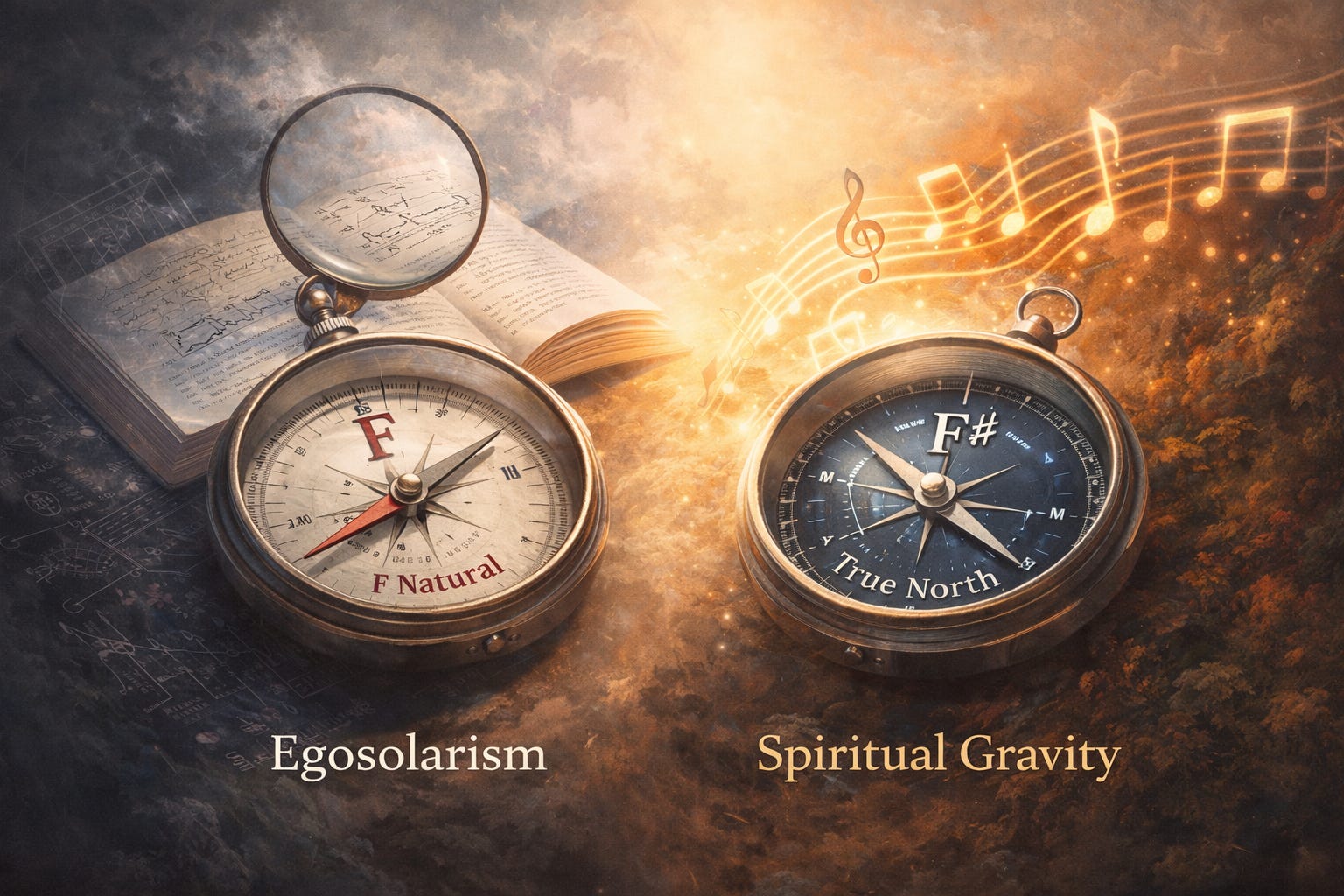
Think of F natural and F♯ as two “compasses” that look almost identical but don’t actually point to the same place.
In music, they’re only a half-step apart. To an untrained ear, that can sound “close enough,” but any musician knows: if the whole band is tuned to F♯ and the piano keeps landing on F natural, the entire piece carries a subtle tension. Chords don’t resolve, harmonies feel cramped, and everyone has to unconsciously work around that one wrong reference. Over time, the strain is exhausting.
That’s the same logic as being one degree off on a compass. At the starting point, it feels negligible. But the farther you travel, the more that tiny deviation becomes the difference between arriving where you intended and being completely lost.
So in this context: F♯ = the heart’s “true north” — a reference tone of coherence. F natural = ego’s approximation — close enough to feel familiar, but just off enough to bend the whole journey.
Using ego as the compass is like tuning an orchestra to an instrument that was never checked against a pitch pipe. It’s not that ego is evil; it’s simply displaced navigation. When we tune our lives to that slightly-off note, relationships, ethics, and purpose all carry a background wobble we normalize as “just how life is.”
This metaphor works because it shows how a small deviation in our reference point — F natural instead of F♯, ego instead of heart — quietly reorganizes everything around it. Coherence isn’t about being perfect; it’s about tuning to the right center. Once the true pitch is restored, the same players, same instruments, same life suddenly sound and feel different — not because the notes changed, but because the compass did.
You don’t need belief to verify this. You need honesty. You need stillness. You need to ask not whether something is true because it’s popular, but whether it holds up under your own awareness. If you’ve ever watched what happens when someone shifts from the head to the heart — you’ve seen the signal change. If you’ve ever watched a person drop their story long enough to feel their pain fully — you’ve seen coherence return.
Spiritual gravity is as real as physical gravity. Egosolarism has consequences you can track — in suicidality, in political polarization, in the disembodiment of AI, in our inability to hold discomfort without collapsing into identity. These aren’t metaphors. They’re the result of living from a center that was never meant to hold the weight.
So yes, I believe in rigor. But the kind of rigor that asks: Am I willing to see what’s right in front of me, even if it costs me the illusion I’ve built? That’s the kind of rigor I trust. That’s the kind that frees.
Because presence doesn’t need to be proven. It just needs to be recognized.
And love — real love, coherent love, the kind that isn’t performative — is not a feeling or a philosophy. It’s the natural state we return to when ego steps aside. It’s the frequency we were born into. It’s the tone of F#. And like gravity, it doesn’t care whether you believe in it. It simply is.
Thanks for reading The Humane Spectrum! Subscribe for free and receive my eBook Galileo’s Unfinished Lesson: How Ego Distorted Human Evolution & How We Fix It.