
After The Fireworks: Restoring the Heart of a Nation
This book is not about politics as usual. It is about what happens when a country loses its coherence — and what may still bring it back.

I chose to announce the release of Restoring the Heart of a Nation today because this time in our country carries a deep meaning — Independence Day. A moment each year when America most publicly remembers its origin story. We gather under flags, fireworks, parades, speeches, songs, and rituals of belonging, and for a brief moment, the nation rehearses the story it still wants to believe about itself. We celebrate freedom, but rarely pause long enough to ask whether we still understand the maturity freedom requires. We celebrate independence, but often without asking whether independence can survive when the people entrusted with it become reactive, divided, exhausted, and less able to feel the coherence of the republic they inherited.
Restoring the Heart of a Nation is not a patriotic performance, nor another contribution to political noise, nor is it an attempt to declare who loves the country more. Rather, it is a way of returning the day to a deeper question. What are we actually celebrating if the country can no longer perceive when its own field has bent out of shape? What does freedom mean if the civic body has become so saturated with fear, grievance, spectacle, and performance that discernment itself begins to fade? What happens when a nation still has its Constitution, courts, elections, amendments, ceremonies, and symbols, but no longer shares the coherence necessary to use them as they were intended?
This article comes after the holiday, on July 6th, because there is something honest about speaking after the fireworks have ended. The noise has passed. The smoke has cleared. The flags may still be hanging, but the deeper question remains in the air. What now? What do people do after celebrating freedom if they sense, somewhere beneath the slogans, that freedom has become confused with self-interest, liberty with entitlement, patriotism with possession, and constitutional loyalty with whatever confirms the side one already occupies?
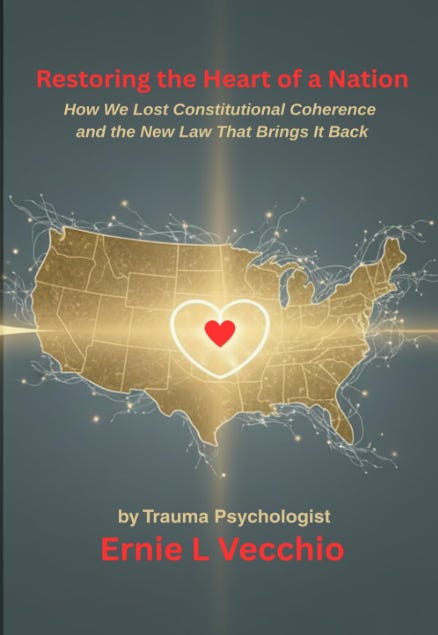
Restoring the Heart of a Nation: How We Lost Constitutional Coherence and the New Law That Brings It Back was written in response to that question. Although its subject is the United States, it is not a book about politics in the usual sense. I did not write it to persuade one side, condemn another, or add another argument to a national conversation already drowning in argument. I wrote it because, as a trauma psychologist, I have spent decades watching what happens when a living system loses coherence. I have come to recognize that people are not the only systems that bend under unresolved pressure. Families bend. Institutions bend. Cultures bend. Nations bend. And when the bend goes unmeasured long enough, people begin to mistake distortion for normal life.
The Constitution, as I understand it in this work, was never meant to be a dead document. It was never meant to function as a frozen relic or partisan weapon. It was designed as a living scaffold for self-correction, a framework built by people who understood, however imperfectly, that human beings are prone to distortion. The framers did not assume purity. They assumed ambition, fear, faction, self-interest, and the dangers of concentrated power. So they built checks and balances, distributed authority, staggered responsibility, and created a civic architecture meant to prevent any one force from becoming the whole. In psychological language, they designed a system to keep egoic force from becoming the center of the field. The manuscript names the Constitution as a living scaffold for national maturation, a design meant to help the country see itself, correct itself, and grow. What they did not have was a way to measure when the field itself had begun to curve.
That is the missing law this book tries to name.
The law offered in the book is not presented as a political doctrine, a spiritual slogan, or a replacement for constitutional law. It is a way of understanding distortion. It says, in essence, that suffering increases when the adaptive ego overwhelms the heart’s capacity to orient perception, and that suffering decreases when ego and heart return to right relationship. It gives language to the bend in a person, a family, a culture, or a nation when fear, identity, defense, control, and self-reference become stronger than coherence, truth, reciprocity, and humane direction.
This law did not come from political theory. It came from the clinical room. It came from sitting with suffering people long enough to notice that their pain often behaved less like pathology and more like curvature. When the ego became exaggerated through defense, shame, fear, control, or wounded interpretation, suffering intensified. When the heart returned as compass, perception softened, the story loosened, the body changed, and something quieter and more coherent began to reorganize the person from within. Over and over again, in trauma, grief, disability, despair, abuse, guilt, shame, and loss, the same pattern appeared. Suffering was not simply something to suppress. It was a signal. It was the psyche’s way of revealing that life had bent too far from its true center.
Once I saw this in people, I could no longer avoid seeing it in the nation.
A country also carries memory. It also carries wounds. It also develops defenses. It repeats patterns it has not integrated. It organizes around stories that protect it from grief. It projects shadow onto the other side and calls that projection virtue. It clings to symbols when it can no longer feel the living meaning beneath them. Like a traumatized individual, a nation can continue to function while no longer feeling whole. It can hold elections, pass laws, debate rights, and invoke founding ideals while its deeper field becomes reactive, brittle, numb, and increasingly unable to process its own distress.
This is why I speak in the book of constitutional coherence. The Constitution was not merely a legal structure. It was a design for proportion. It was a way of holding tension without collapse, disagreement without dehumanization, ambition without tyranny, and liberty without disintegration. It assumed that the people would grow in their capacity to govern themselves, not only procedurally, but psychologically and ethically. It assumed that a republic required citizens capable of discernment, restraint, perspective, shared responsibility, and enough humility to understand that freedom without coherence eventually turns against itself.
That assumption is now being tested.
We call the current condition polarization, but polarization is only the surface shape of the problem. We call it division, mistrust, outrage, culture war, extremism, institutional breakdown, or political fatigue, and each of those words names something real. But beneath them is a deeper curvature. The nation has begun orbiting the wrong center. Public life has become organized around performance more than presence, certainty more than discernment, reaction more than reflection, grievance more than grief, and victory more than coherence. The ego of the nation has become louder than the heart of the nation, and once that happens, law may remain intact while meaning begins to collapse.
This is the difference I am trying to name. A nation can preserve the form of democracy while losing the felt field that makes democracy livable. It can continue to talk about liberty while forgetting that liberty requires self-governance. It can continue to honor the Constitution while no longer allowing the Constitution to function as a mirror. It can celebrate July 4th with great volume while quietly avoiding the question of whether the republic still knows how to mature beyond its origin story.
Announcing this book on July 6th was my way of placing that question back into the holiday itself. Not to diminish the celebration, but to deepen it, because love of country, if it is real, cannot be only celebratory. It must also be discerning. It must be able to notice when the thing loved is suffering. It must be able to distinguish loyalty from possession, reverence from idolatry, freedom from egoic entitlement, and constitutional faithfulness from the selective use of the Constitution as a shield against one’s own distortion. A people that cannot tell these differences may still call itself free, but it will become increasingly vulnerable to spectacle, manipulation, and the charisma of those who know how to turn grievance into identity.
This is why the heart matters.
In this book, the heart is not used as a metaphorical softness. It is not a call for everyone to be nicer, quieter, more agreeable, or more emotionally expressive. The heart is the faculty of coherence. It is the perceptual center through which truth, proportion, relational integrity, and humane direction can be felt before the ego turns reality into a possession. The heart can be tender, but it can also be exacting. It can say no. It can set boundaries. It names distortion without humiliating the person caught inside it. It can recognize suffering as a signal without turning suffering into identity. It can guide law back toward life. The manuscript describes the heart as the system’s coherence vector, the inner field that organizes perception around truth, integration, and relational integrity.
This is what the nation has lost, or perhaps more accurately, what the nation has stopped trusting.
We have elevated opinion over discernment, performance over presence, data over wisdom, ideology over relationship, and outrage over honest grief. We have trained ourselves to believe that what is loud is strong, what is certain is true, and what is legally defensible is necessarily coherent. But law without heart becomes procedure without pulse. Freedom without heart becomes self-interest with better language. Patriotism without heart becomes possession. Governance without heart becomes control.
The purpose of the law described in the book is not to moralize this condition. It is to reveal the bend.
That is why this book matters now. It does not ask readers to agree with me politically. It asks them to consider whether our national suffering is more structural than partisan, more psychological than procedural, and more perceptual than ideological. It asks whether the crisis beneath our crises is the loss of a shared instrument for detecting distortion. It asks whether we can still feel when the field has become incoherent, and whether we have enough courage to name that incoherence without turning the naming into another weapon.
This distinction is essential. The law in this book is not a tool for diagnosing leaders. It is not a way to pathologize voters or shame public figures. It concerns field conditions. It asks whether a policy, a debate, a cultural moment, an institution, or a national posture increases or decreases coherence. It asks whether egoic amplification has overwhelmed the heart’s capacity to orient the field. It asks where suffering is being created, intensified, ignored, displaced, or normalized. It asks what would restore alignment.
In this sense, the law does not replace the Constitution. It gives the Constitution a mirror it never had.
The framers gave us a structure designed to hold tension. They could not foresee an age when amplification would move faster than discernment, when outrage would become profitable, when identity would harden into political religion, when public figures could bend entire fields of perception in real time, or when a people could be flooded with information while starving for coherence. Their architecture remains remarkable, but architecture without feedback becomes brittle. A bridge needs stress sensors. A body needs a nervous system. A democracy needs a way to feel when its field is bending beyond what its structure can absorb.
That is the work this book begins.
It is not a finished answer. It is an instrument. It is a way of saying that we can no longer measure only votes, polls, markets, crime rates, approval numbers, and institutional outcomes while ignoring the curvature of the human field beneath them. We can no longer wait until despair becomes addiction, politics becomes violence, leadership becomes spectacle, and citizens become numb before admitting that the system has been signaling distress for a long time.
July 4th reminded us that America declared independence. July 6th asks whether we are willing to grow into coherence.
That is the harder work, and perhaps the more necessary one now.
The fireworks are gone. What remains is the field we must live in together. The question is whether we can listen beneath the noise long enough to feel what the field is telling us. Can we restore the heart of a nation without turning that heart into another slogan? Can we honor the Constitution not by freezing it, but by allowing it to breathe again as a living framework for national maturation? Can we stop mistaking ego for compass, performance for patriotism, and legal form for living coherence?
I wrote Restoring the Heart of a Nation because I believe the answer can still be yes. Not easily, not automatically, not because any party will save us, and not because one election will repair the field, but because the heart of the nation is not gone. It has been buried beneath fear, distortion, spectacle, and the exhaustion of a people who still sense that the American experiment was meant to mean something more.
The door remains open because coherence can still return, but it will not return through louder certainty. It will return through discernment, humility, measurement, courage, the willingness to feel where the field has bent, and through enough of us remembering that freedom was never meant to orbit the ego.
Freedom was meant to become humane.
Thanks for reading The Humane Spectrum! Subscribe for Free to receive my eBook Galileo’s Unfinished Lesson: How Ego Distorted Human Evolution & How We Fix It.